Mexico’s President Signs Decree to Regulate Violent Content on Digital Platforms: How It Will Affect Social Media and Video Games
By Daniel Laguna onClaudia Sheinbaum’s government wants to prevent children and teenagers from being exposed to inappropriate content

This week, the Mexican government introduced the Safe Digital Environments Decree for Children and Teenagers, which aims to regulate violent content on digital platforms. Claudia Sheinbaum explained that the initiative seeks to protect younger users, who are constantly exposed to violent and inappropriate content that poses risks to their safety and mental health.
The decree gives digital platforms a deadline to improve and adjust their systems. The goal is to prevent certain types of content from reaching minors through social media, video games, and other digital environments where they interact with other people. Companies will have to demonstrate compliance with the requirements and will also be required to remove content when necessary.
Mexico will create safe digital environments for children and teenagers. What content will the government regulate?
On October 9, Mexico’s president presented her plan to regulate content on digital platforms. The announcement came after at least four violent incidents were reported at schools in different states across the country. According to authorities, all of these cases involved communication through social media and other digital platforms.
As a result, the government considered it urgent to introduce restrictions on digital platforms regarding the distribution of content related to hate speech, violent extremism, abuse, exploitation, and sexual violence. Authorities also want to regulate content related to suicide, deliberate self-harm, eating disorders, school violence, harassment, illegal activities, and explicit sexual material.
The government’s proposal is for companies operating digital platforms to voluntarily join the initiative. As a result, there will be no penalties for the time being, but companies are expected to commit to fulfilling the new obligations.
“What this establishes is that they have an obligation to take down content and report it to the authorities through a permanent connection with the National Guard and the Secretariat of Security and Citizen Protection. If they fail to comply, further regulations will be considered. It is mandatory; it is not a matter of whether they want to comply or not. We will engage in dialogue with them to determine what they need to do to comply with the decree,” the president stated.
Following discussions with Meta, Microsoft, Apple, TikTok, Google, X, and other companies, an agreement was reached to regulate violent content. Sheinbaum stressed that several recent crimes involving minors were organized through social media, which is why she believes it is important to control the “promotion of violence,” including in video games.
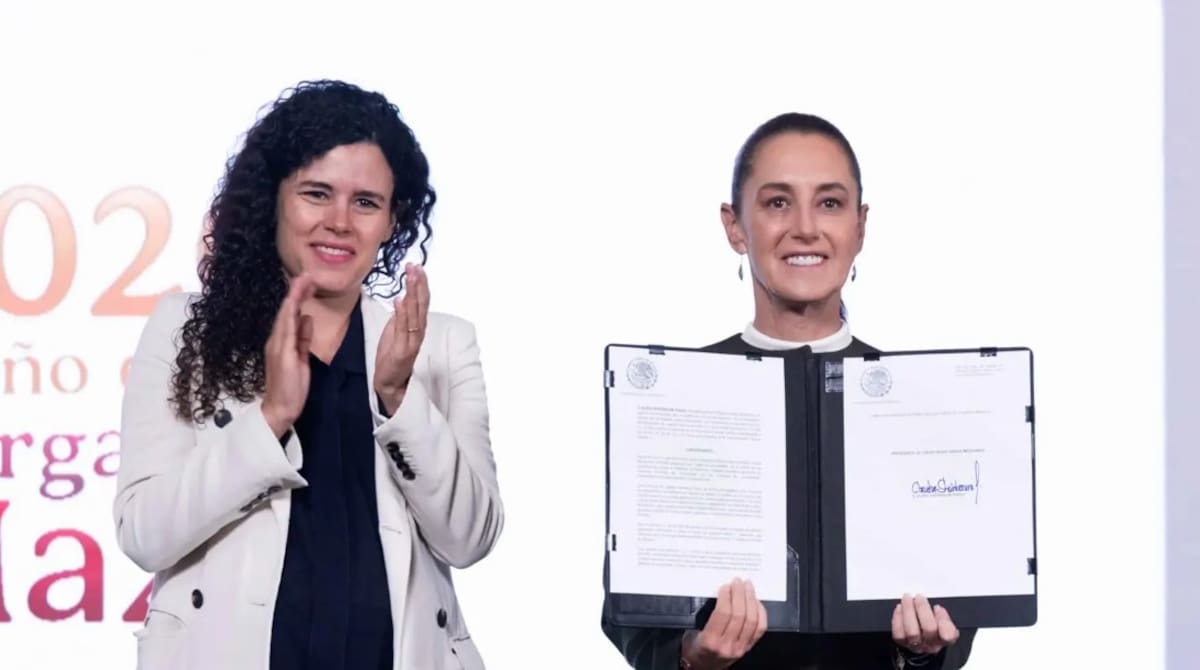
Luisa María Alcalde Luján and Claudia Sheinbaum during the signing of the Safe Digital Environments Decree.
The decree was published this week in the Official Gazette of the Federation (DOF), meaning digital platforms are now required to “restrict exposure by design to content involving violence, harassment, or sexual abuse, as well as immediately remove any harmful material from minors’ profiles.”
During her morning press conference on October 14, Mexico’s president confirmed that companies had agreed to make changes to their platforms to protect minors. She reiterated that if companies fail to comply, the government will propose legislation to penalize them.
Luisa María Alcalde Luján, legal adviser to the federal executive branch, explained that companies will have 30 calendar days to make the necessary adjustments to their platforms and document the measures they have implemented for submission to the authorities.
How will the decree affect social media and video games?
Authorities highlighted that more than 85% of the population between the ages of 6 and 14, as well as 97% of people between the ages of 15 and 24, use the Internet. For this reason, they consider regulating violent content a priority across all digital platforms where young people can interact and communicate.
Officially, the regulatory initiative will affect social media, video games, app stores, and other digital environments. One of its main requirements is to restrict content that threatens young people’s safety and mental health.
To achieve this, social media platforms and gaming platforms will have to implement effective age-verification mechanisms, as well as criteria for classifying users by age. Companies will also be required to immediately remove inappropriate content from minors’ accounts and provide reporting tools.
Digital platform owners will have to report their progress to the authorities.
Digital environments will also have to strengthen their parental control tools and general security measures, and ensure that new user accounts have the strongest privacy settings enabled by default.
“Effective protection for children and teenagers in the digital environment requires coordinated action by the authorities and the cooperation of individuals and legal entities that operate or manage digital platforms, particularly through mechanisms that make it possible to identify, report, and promptly address content involving forms of violence that affect the rights of children and teenagers,” Claudia Sheinbaum added.

About the author

Recommended For You
 News
NewsAll Episodes of Demon Slayer: Kimetsu no Yaiba Arrive on Another Popular Streaming Service, Making It Easier Than Ever to Watch the Anime and Movies With Latin American Spanish Dubbing
 News
NewsThis SEGA Game Received Thousands of Negative Reviews and Had Such a Disastrous Launch That It Will Be Pulled From Sale Just 2 Days After Release
 News
NewsOne of the Best Games of 2026 and a Potential GOTY Contender Won’t Launch on Xbox to Boycott Microsoft
 News
News
Comentarios
Inicia sesión desde el menú superior para dejar un comentario.
Sé el primero en comentar.